Understanding Pistol Optics
Open Emitter Optics
Open emitter optics have an exposed LED mounted inside an unsealed housing. Light is projected directly toward the shooter's eye without a front lens over the emitter.
They are typically lighter, smaller, and less expensive than enclosed designs, with better window clarity and a wider selection of mounting solutions across pistol platforms.
The tradeoff: the emitter is exposed to the environment. Mud, water droplets, or debris landing on the emitter can block or obscure the dot. They require more attention in adverse conditions and high-round-count training.
Enclosed Emitter Optics
Enclosed emitter optics seal the LED behind a forward lens, protecting it from direct environmental exposure. The entire optical path is housed inside a sealed body.
They are more reliable in rain, dust, and hard-use environments. The emitter cannot be fouled by debris, making them better suited for duty use and prolonged field exposure.
The tradeoff: typically heavier, larger, and more expensive. The front lens adds a surface that can fog or accumulate contamination from the outside. Some models have a smaller usable window than comparable open emitters.
Dot Size: What MOA Means
Dot size is measured in MOA (Minute of Angle) — an angular unit that scales with distance. It is not a fixed physical size.
1 MOA covers approximately 1 inch at 100 yards. At 50 yards it covers half an inch. At 25 yards, a quarter inch.
| Dot Size | Characteristics |
|---|---|
| 1–2 MOA | Small, precise. Good for distance. Can be harder to acquire quickly under stress or in bright light. |
| 3 MOA | General purpose. Balances speed and precision for most defensive and duty applications. |
| 5–6 MOA | Fast to acquire. At 100 yards the dot covers 5–6 inches of the target, which limits precision at distance. |
| 8+ MOA | Maximizes close-range speed. At distance the dot covers a significant portion of the target. |
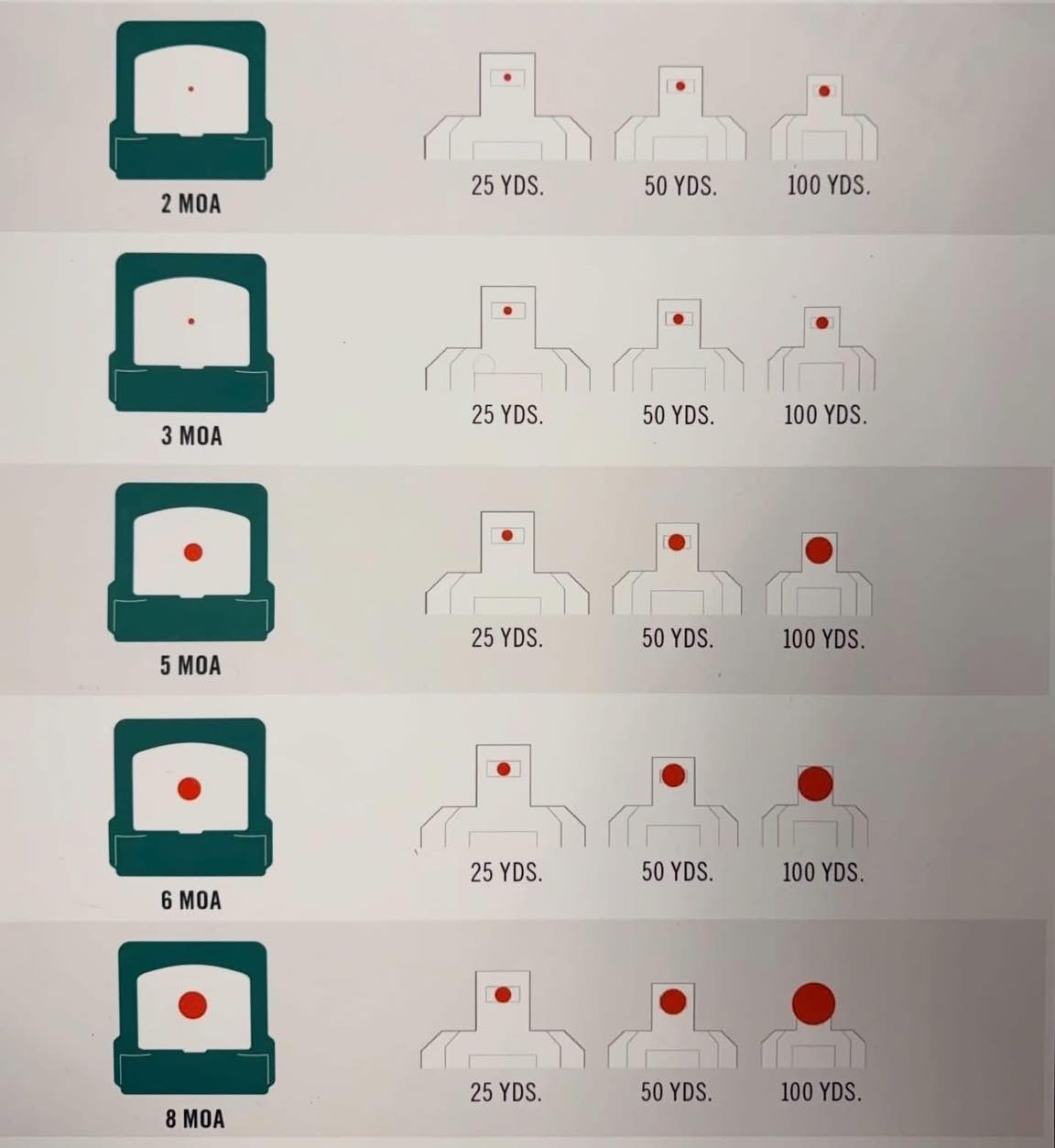
Why Dot Size Matters
Your effective precision cannot exceed your dot size. If your pistol is mechanically capable of 2 MOA accuracy but you are running a 6 MOA dot, the dot becomes the limiting factor at distance.
This is not a flaw — it is a deliberate tradeoff. Dot size should be selected based on your expected engagement distances, vision, any astigmatism, and the balance between speed and precision your use case requires.